Media Literacy Project
Project Number: 2019-1-IT02-KA229-063301
Media literacy education is intended to promote awareness of media influence and create an active stance towards both consuming and creating media.

The Project
The project ‘Media Literacy’ was coordinated by school “IIS Margherita Hack” (IT) and it involved 2 more partners: Vocational High School of Power Engineering and Electrical Engineering, Galabovo (BG) and “Barcelinhos Secondary School” (PT). The project was supposed to last two years but its duration was extended to three years due to Covid-19.
The project was based on the following considerations and needs: nowadays we observe the increasing impact of media, especially digital, on society’s formative processes. It is important that teachers take into account seriously students interests in media and help them express their interests and viewpoints by using the media. The changes and dynamics in the public life in the 21st century also impose the need of a rapid adaptation of the educational sphere meaning that teachers should constantly improve their competences and adapt to the fast-paced changing educational realities in terms of new innovative teaching methods and approaches.
Objectives
The main objective of the project was the acquirement of media literacy competences (including digital and information literacy competences) of the students understood as the ability to access media, understand and critically evaluate different aspects of the media and media contexts and create communication in a variety of contexts. The project also aimed at the exchange of experience and good practices between teachers along with elaboration of suiting activities and approaches in order to promote media literacy among a wider educational community, which can be subsequently integrated in teaching practices. By participating in the project the profile of the teaching profession will be strengthened by supporting them to deliver high quality education and adopt new innovative methods and approaches. All the abovementioned become even more urgent and relevant due to Covid-19 that imposed the use of ICTs for remote learning.
ACTIVITIES
The transnational activities carried out during the project implementation were:
- n. 3 Joint staff training events
- n. 3 Transnational mobility activities of students (supported dy accompanying person). Each Mobility activity has been held at the same time as the related training activity for the teachers
The activities in the project took the form of exchange of practices, laboratories, presentations, demonstrations, role-plays, individual and group tasks, simulations, group discussions, brainstorming, mind maps, etc. The schools hosting the events have organized also cultural visits that had the objective to make participants familiar with the different context, observe and reflect upon art as a media of expression. Teaching and learning materials have been prepared by each school in English. Other materials (including videos) have been created during the events and laboratories abroad. Then, all materials have been translated into the languages of the partnership to be used within the schools and they have been made available to the broader public on the project website and the E+ Dissemination Platform.
Topics
The topics treated during the joint staff training events and the laboratory for students were:
- Digital and media literacy (during mobilities in Italy);
- Facts vs fiction or how to address disinformation (during mobilities in Bulgaria);
- Creation of media contents (during mobilities in Portugal).
During the transnational activities for students and teachers different specific themes have been treated, such as: media, media functions, freedom of expression, media content creation, disinformation, fake news, ICT tools, new learning and teaching methods through ICTs. Different innovative methods and approaches have been applied and adopted.
Result
The results of the project are as follows. For the students: development of essential media literacy competences; ability to search and filter information and content; evaluate and analyze media content; deconstruct media messages (source, audience, text, subtext, persuasion techniques, point of view, etc.); create own media products (presentations, videos, websites, etc.); development of critical thinking, problem solving, analysis and evaluation competences, critical understanding skills, etc..For the teachers: increase of opportunities of exchange of best practices with foreign colleagues, share and discussion of ideas, observation of different teaching approaches; establishment of a transnational cooperation, creation and deepening of partnerships. In the long term, it is expected that new innovative teaching methods and approaches will be integrated in the teaching practice long with the development of strategies to promote media literacy while delivering lessons in teacher’s subject areas. All participants, taking part in the project activities, developed soft skills such as: intercultural, digital, foreign languages competences, ability to work in team, creativity, capacity to interact with peers, etc.
Partnership
News
Wellbeing – inspiration from ERASMUS+ projects
What specific needs should we respond to if we want to offer pupils and students effective support in well-being? What can we offer to young people to prevent the adverse development of children’s mental well-being growing into serious psychological problems?
In the STAY+ project, an international group consisting of organizations from UK, the Czech Republic, Italy and Turkey dealt with this topic and now presents its outputs on the website www.stayplusproject.eu.
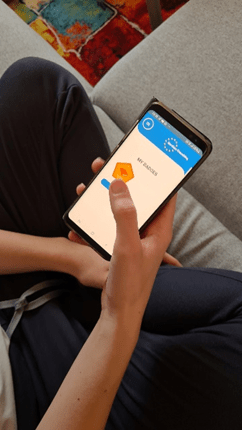
The main output is a mobile platform that motivates a healthy lifestyle with a positive attitude. Other outputs include studies, analyses, survey results.
Three-quarters of students experience excessive stress or anxiety (GTS Alive survey of high school and college students in Fall 2022). We supplemented the survey by directly interviewing students at secondary schools and universities, and we are getting interesting suggestions.
Speed – young people spend time on social networks, specifically those that convey information to them briefly and quickly. The STAY+ mobile platform works on a similar principle, the user chooses a topic, e.g. sleep, where he or she can watch a short video about sleeping habits. The user then answers two simple questions and earns a “sleep badge”.
Anonymity and simplicity – in order for an application to be widely used by young people, it must be easily accessible, without the need to create accounts and provide personal information to the operator. The STAY+ mobile platform works in a mobile browser, i.e. on a regular mobile phone from the website stayplusproject.eu. To access badges (rewards), only activation via phone number or email is required.
Sharing – today, pupils or students usually do not distinguish between social and individual activities. They also want to be able to present and share activities that they do only for themself, which, for example, serve for personal development. On the STAY+ mobile platform, you can show off every badge you earn.
Form and content – the form of the STAY+ mobile platform was created to suit the target group as much as possible, to resemble a simple social network in its control and flow. By combining images, videos and simple key words, they do not try to replace professional support. However, the content brings tips on well-being, food for thought, inspiration for a walk in nature, exercise, exercise and a healthy lifestyle.
The STAY+ initiative is not the only one, a number of schools are involved in ERASMUS+ projects, where the topic of well-being has been developed for several years and inspiration can be found among examples of good practice
medialiteracy202021.video.blog
This project has been funded with support from the European Commission. This publication reflects the views only of the author, and the Commission cannot be held responsible for any use which may be made of the information contained therein.
 Media Literacy